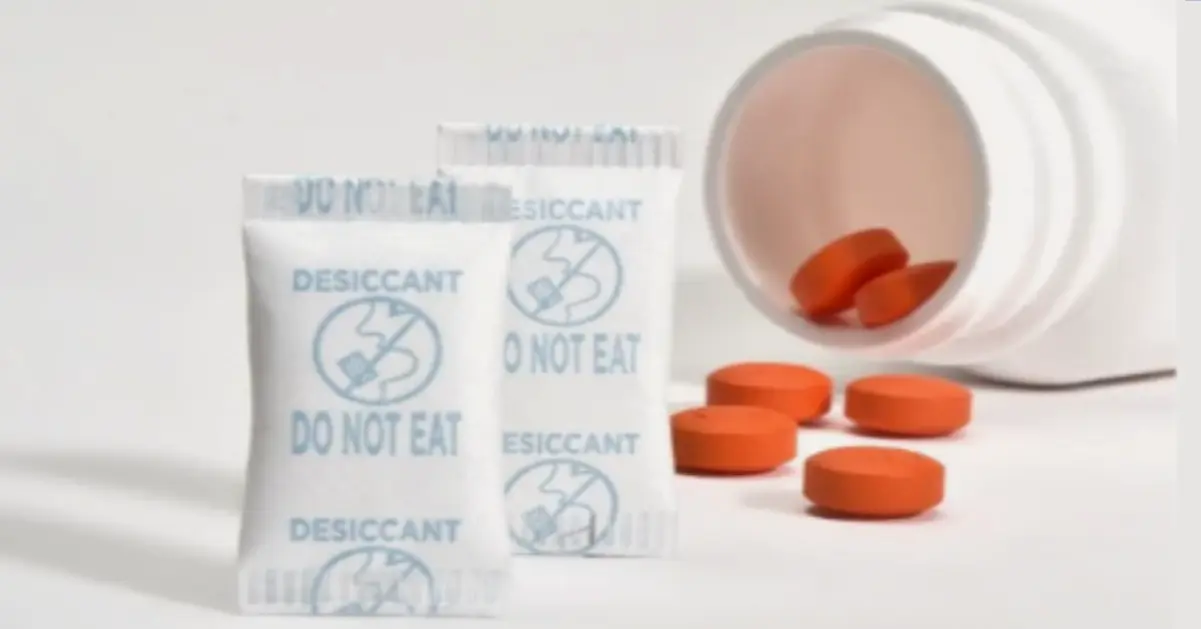
Pharmaceutical desiccants in UAE help protect moisture-sensitive medicines, active pharmaceutical ingredients (APIs), nutraceuticals, medical devices, and healthcare products during storage and transportation. By controlling humidity inside packaging, desiccants can help maintain product stability, quality, and shelf life.
Common options include silica gel, molecular sieves, desiccant sachets, and canisters, each suited to different packaging and moisture-control requirements. This guide covers the major types, applications, benefits, and selection factors for pharmaceutical desiccants used by pharmaceutical companies and packaging suppliers in t
What Are Pharmaceutical Desiccants?
What are pharmaceutical desiccants? They are moisture-absorbing materials designed to reduce humidity inside sealed packaging and protect products that can be affected by exposure to water vapor.
A desiccant attracts and retains moisture from the surrounding air within a package. Depending on the material, this moisture may be physically adsorbed onto the surface or captured within the material’s pore structure.
Common materials used for pharmaceutical moisture protection include:
- Silica gel
- Molecular sieve
- Activated clay
- Activated carbon in selected applications
- Other specialized moisture-control materials
Pharmaceutical products can be sensitive to environmental moisture. Depending on the formulation, moisture exposure can contribute to changes such as:
- Loss of product stability
- Changes in tablet hardness
- Capsule deterioration
- Chemical degradation
- Clumping or sticking
- Changes in physical appearance
- Reduced shelf-life performance
A suitable pharmaceutical desiccant helps reduce the amount of available moisture within the packaging environment.
This makes desiccants an important component of moisture protection for pharmaceuticals, particularly for products packaged in bottles, containers, blister systems, pouches, or other sealed formats.
How Do Pharmaceutical Desiccants Work?
Understanding how pharmaceutical desiccants work starts with the concept of adsorption.
When a pharmaceutical package is sealed, the air inside the package contains a certain amount of water vapor. Moisture can also enter through packaging materials or remain in the headspace during packaging. A desiccant placed inside the package captures moisture from this environment.
The basic process is:
Moisture-containing package → Desiccant captures water vapor → Lower internal humidity → Improved moisture protection
Different desiccants have different adsorption capacities and operating characteristics. Therefore, the right material must be selected based on the product and packaging environment.
Major Types of Pharmaceutical Desiccants
Different materials can be used depending on the required moisture-control performance.
The most common options include silica gel and molecular sieve, along with other specialized desiccant materials.
Silica Gel for Pharmaceutical Packaging
Silica gel for pharmaceutical packaging is one of the most widely recognized desiccant solutions. It is a porous form of silicon dioxide with a high surface area and strong affinity for water vapor.
It is commonly supplied in forms such as:
- Sachets
- Packets
- Pouches
- Canisters
- Other customized packaging formats
Pharmaceutical silica gel can be selected for applications involving tablets, capsules, nutraceuticals, and other moisture-sensitive products.
Its widespread use makes silica gel a practical option when moderate-to-high moisture adsorption is required within a sealed package.
Molecular Sieve for Pharmaceutical Packaging
Molecular sieve for pharmaceutical packaging is another important moisture-control option. Molecular sieves are crystalline adsorbents with highly controlled pore structures. Certain grades have a particularly strong affinity for water and can provide low residual moisture levels.
Pharmaceutical molecular sieve can be used where tighter moisture control is required than may be practical with some other desiccant materials. Molecular sieve products can be incorporated into:
- Sachets
- Packets
- Canisters
- Pillow-type packs
- Specialized pharmaceutical packaging
The correct molecular sieve grade should be selected based on the moisture specification, packaging environment, product sensitivity, and required adsorption performance.
Pharmaceutical Desiccant Canister
A pharmaceutical desiccant canister is a rigid desiccant container designed to fit inside certain pharmaceutical bottles and containers.
Canisters can offer several practical advantages:
- Controlled placement inside bottles
- Reduced risk of loose particles
- Consistent physical structure
- Compatibility with automated packaging systems
- High moisture-adsorption capacity depending on the desiccant material
Canisters can be manufactured using different desiccant materials, including silica gel and molecular sieve, depending on the application.
They are commonly considered for tablet and capsule packaging where moisture control is important.
Pharmaceutical Desiccant Packets
Pharmaceutical desiccant packets provide a convenient way to introduce moisture protection into sealed packages.
They can contain materials such as silica gel or other desiccants and can be manufactured in different sizes according to the packaging requirements.
They may be used with:
- Medicine bottles
- Nutraceutical containers
- Supplement packaging
- Pharmaceutical products
- Diagnostic products
- Certain medical devices
The appropriate packet size should be determined based on package volume, moisture load, storage conditions, and required protection period.
Pharmaceutical Desiccants Applications
Pharmaceutical Desiccants for Tablets
Desiccants for tablets can help protect solid dosage forms that are sensitive to moisture.
Depending on the formulation, moisture may affect tablet characteristics such as:
- Hardness
- Disintegration
- Appearance
- Stability
- Physical integrity
A suitable desiccant can reduce humidity inside the packaging environment.For bottle-packed tablets, a desiccant canister or packet may be selected depending on the packaging design.
Desiccants for Capsules
Desiccants for capsules are used to help control humidity in capsule packaging.
Capsules may be sensitive to environmental moisture depending on their composition and formulation. Excessive humidity can affect their physical properties and potentially influence product stability.
Silica gel and molecular sieve can be considered depending on the required moisture-control level and packaging configuration.
Desiccants for API Packaging
Active pharmaceutical ingredients can be particularly sensitive to moisture.
Desiccants for API packaging are used to help maintain controlled storage conditions for moisture-sensitive active ingredients during manufacturing, storage, and transportation.
The selection process should consider:
- API moisture sensitivity
- Packaging volume
- Storage duration
- Packaging barrier properties
- Temperature and humidity
- Required moisture level
- Desiccant capacity
A suitable moisture-control solution can complement high-barrier packaging to help protect APIs throughout the supply chain.
Desiccants for Nutraceutical Packaging
Nutraceuticals, vitamins, minerals, herbal products, and dietary supplements can also be affected by humidity.
Desiccants for nutraceutical packaging can help control moisture in bottles, pouches, and other sealed containers.
Applications may include:
- Vitamin tablets
- Mineral supplements
- Herbal capsules
- Powdered supplements
- Nutritional products
The appropriate desiccant depends on the formulation and packaging design.
Desiccants for Medical Devices
Some medical devices and healthcare products can be affected by moisture during storage.
Desiccants for medical devices can help reduce humidity inside sealed packaging where moisture control is required.
The desiccant solution should be selected based on:
- Device sensitivity
- Packaging material
- Package volume
- Storage conditions
- Required shelf life
- Regulatory requirements
Desiccants for Injectable Pharmaceuticals
Injectable pharmaceuticals require careful consideration because injectable products have strict quality and packaging requirements.
Where moisture protection is relevant, desiccants may be used in the secondary packaging or external packaging environment rather than being placed directly with the pharmaceutical formulation.
The exact approach depends on the product, container-closure system, packaging configuration, and applicable regulatory requirements.
Silica Gel vs Molecular Sieve for Pharmaceuticals
One of the most common questions is silica gel vs molecular sieve for pharmaceuticals.
Both materials can provide moisture adsorption, but their properties differ.
| Feature | Silica Gel | Molecular Sieve |
| Moisture adsorption | High | Very high for suitable grades |
| Pore structure | Broad | Highly controlled |
| Deep drying | Application-dependent | Particularly suitable |
| Common formats | Packets, sachets, canisters | Packets, canisters, specialized packs |
| Pharmaceutical use | Widely used | Used where tighter moisture control is required |
| Selection | Depends on package and product | Depends on required moisture specification |
There is no universal answer to which material is better.
The best desiccant for pharmaceutical products depends on the moisture sensitivity of the product, package volume, expected environmental conditions, required shelf life, and target humidity.
How to Choose a Pharmaceutical Desiccant?
Knowing how to choose a pharmaceutical desiccant can help manufacturers avoid both under-protection and unnecessary material usage.
1. Understand Product Moisture Sensitivity
Determine how strongly the pharmaceutical product reacts to moisture.
2. Evaluate Package Size
Larger packages may require greater desiccant capacity.
3. Consider Packaging Materials
The moisture-barrier properties of the container or pouch influence how much moisture can enter during storage.
4. Analyze Storage Conditions
Temperature, relative humidity, transportation conditions, and expected exposure should be considered.
5. Determine Required Protection Period
The desiccant must provide adequate capacity throughout the intended storage and distribution period.
6. Select the Appropriate Material
Silica gel, molecular sieve, and other desiccants have different characteristics and should be selected based on the application.
7. Choose the Correct Packaging Format
Packets, sachets, canisters, and pillow packs provide different physical configurations.
Benefits of Pharmaceutical Desiccants
Using a suitable desiccant can provide several benefits for moisture-sensitive products.
Moisture Control
Desiccants reduce available water vapor within sealed packaging.
Product Protection
They can help protect moisture-sensitive medicines and healthcare products from humidity-related changes.
Improved Packaging Stability
Maintaining a controlled internal environment can support product stability during storage.
Support for Shelf-Life Requirements
Effective moisture management can contribute to maintaining product quality throughout the intended shelf life.
Flexible Packaging Options
Desiccants are available in different forms, including packets, sachets, canisters, and pillow packs.
Application Versatility
They can be used for pharmaceuticals, APIs, nutraceuticals, medical devices, and selected healthcare products.
Conclusion
Pharmaceutical desiccants are an important component of moisture-control strategies for medicines, APIs, nutraceuticals, medical devices, and other moisture-sensitive healthcare products.
OozeChem provides industrial desiccant materials including silica gel and molecular sieve for moisture-control applications. Whether you are looking for a pharmaceutical desiccant supplier UAE, pharmaceutical desiccant supplier Dubai, or pharmaceutical desiccant supplier Abu Dhabi, selecting a reliable supplier with appropriate product specifications and technical support can help ensure consistent moisture protection across your supply chain.