
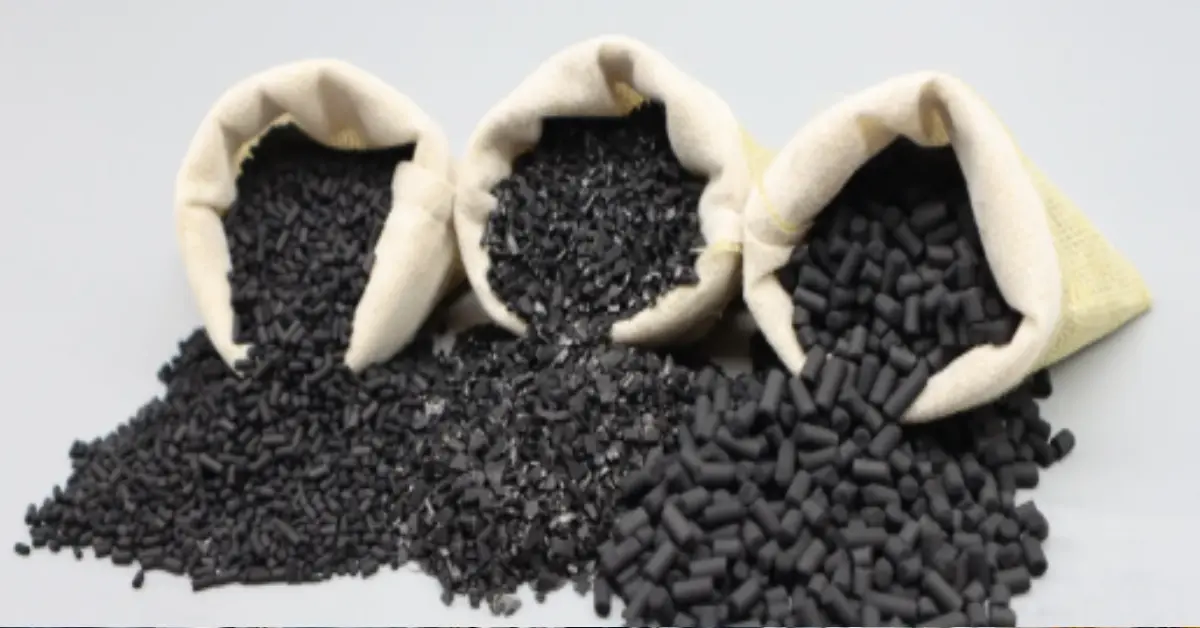
Understanding granular vs powdered activated carbon helps water treatment plants, industrial facilities, air purification systems, food processors, and chemical manufacturers select the appropriate carbon for their process.
Choosing the right form of activated carbon can directly affect adsorption performance, handling, operating costs, and treatment efficiency. The two most widely used forms are granular activated carbon (GAC) and powdered activated carbon (PAC). Although both rely on the same adsorption principle, their particle size, dosing method, contact time, and typical applications are different.
What Is Granular Activated Carbon?
Granular activated carbon (GAC) consists of relatively larger activated carbon particles. Its granular structure allows water or gas to flow through a packed carbon bed while contaminants are adsorbed onto the carbon surface.
GAC is commonly used in fixed-bed systems and continuous-flow treatment processes. Because it can often be removed, regenerated, or reactivated depending on the application, it can be suitable for processes requiring longer-term carbon use.
Common granular activated carbon applications include:
- Drinking water treatment
- Industrial water filtration
- Wastewater treatment
- Air purification
- Odor control
- VOC removal
- Chemical processing
- Solvent recovery
The choice of GAC depends on factors such as contaminant type, flow rate, carbon grade, particle size, and required adsorption capacity.
What Is Powdered Activated Carbon?
Powdered activated carbon (PAC) has much smaller particles than GAC. Its fine particle size provides rapid contact with contaminants, making it useful when activated carbon needs to be added directly to a treatment stream.
PAC is generally mixed into water or another process liquid for a defined contact period. After adsorption, the carbon is typically separated from the treated stream.
Typical powdered activated carbon applications include:
- Drinking water treatment
- Industrial wastewater treatment
- Batch treatment
- Taste and odor control
- Emergency contaminant treatment
- Food and beverage processing
- Process water treatment
Because PAC can be dosed according to changing treatment requirements, it can be useful for processes where contaminant concentrations vary.
Granular vs Powdered Activated Carbon: What Is the Difference?
The main difference between granular and powdered activated carbon is particle size and how the carbon is introduced into the treatment system.
GAC is normally used as a packed filter or adsorption bed, whereas PAC is commonly added directly to a liquid or process stream.
| Feature | Granular Activated Carbon (GAC) | Powdered Activated Carbon (PAC) |
| Particle size | Larger particles | Fine particles |
| Typical use | Fixed-bed systems | Direct dosing or batch treatment |
| Contact method | Flow through carbon bed | Mixed into treatment stream |
| Adsorption response | Controlled and continuous | Rapid contact |
| Separation | Carbon remains in a bed until replacement | Requires separation after treatment |
| Reuse | Can often be regenerated or reactivated | Generally used as a single treatment dose |
| Best suited for | Continuous treatment | Variable or short-term treatment |
Therefore, GAC vs PAC is not simply a question of which carbon is better. The appropriate option depends on the treatment process and operating requirements.
GAC vs PAC: Particle Size and Adsorption Rate
Activated carbon particle size influences how carbon behaves during treatment.
PAC has much finer particles, which can provide rapid contaminant contact. This can be advantageous when treatment requires quick adsorption or when carbon is added for a short period.
GAC has larger particles and is commonly placed inside a fixed bed. Contaminated water or gas passes through the bed, allowing adsorption to occur continuously.
This means GAC vs PAC adsorption rate should be considered alongside contact time, contaminant concentration, carbon characteristics, temperature, flow rate, and system design.
Smaller particles do not automatically mean better overall treatment. A carbon with suitable pore structure and adsorption characteristics must be selected for the target contaminant.
GAC vs PAC for Water Treatment
Both forms can be used for water treatment, but their operating methods are different.
GAC for water filtration is commonly installed in fixed-bed filtration systems. Water passes through the carbon, where organic compounds, taste- and odor-causing substances, and other targeted contaminants can be adsorbed.
PAC water treatment involves adding powdered carbon directly to the water. The carbon remains in contact with the water for a specified period before being removed through the appropriate downstream process.
For continuous treatment systems, GAC filtration can provide a practical long-term adsorption approach. PAC can be more suitable when treatment requirements change frequently or when a rapid carbon dose is required.
GAC vs PAC for Wastewater Treatment
Activated carbon can also support the removal of specific organic contaminants from industrial wastewater.
Granular activated carbon for wastewater treatment is generally used in fixed beds where wastewater continuously passes through the carbon media.
Powdered activated carbon for wastewater treatment can be added to a treatment process where rapid adsorption or flexible dosing is required.
The selection should be based on wastewater characteristics, contaminant concentration, treatment objectives, carbon consumption, and the facility’s ability to handle spent carbon.
For industrial applications, laboratory testing and adsorption studies can help determine which carbon form and grade provides the desired performance.
Granular Activated Carbon for Air Purification
GAC is widely suited to applications involving gas and vapor streams because it can be installed in adsorption beds.
Granular activated carbon for air purification can be used for applications such as:
- VOC adsorption
- Odor control
- Industrial air purification
- Solvent vapor capture
- Gas-phase contaminant removal
In these systems, contaminated air passes through the carbon bed and targeted compounds are adsorbed onto the carbon.
The appropriate carbon grade depends on the contaminant, concentration, humidity, temperature, airflow, and required operating time.
GAC vs PAC: Reusability and Regeneration
Another important consideration when comparing GAC and PAC is activated carbon reusability.
GAC is commonly better suited to regeneration or reactivation because it can be recovered from a fixed-bed system. Depending on the contaminant and carbon type, spent GAC may be thermally reactivated and returned to service.
Granular activated carbon regeneration can help extend carbon service life and reduce the amount of spent carbon requiring disposal.
PAC is generally more difficult to recover after use because its fine particles are dispersed throughout the treatment process. For this reason, PAC is often treated as a consumable material.
The feasibility of regeneration depends on the adsorbed contaminants, carbon properties, operating conditions, and available regeneration technology.
GAC vs PAC Cost: What Should Buyers Consider?
The GAC vs PAC cost comparison should not be based solely on the purchase price per kilogram.
A complete cost evaluation may include:
- Carbon dosage
- Carbon consumption
- Equipment requirements
- Replacement frequency
- Regeneration options
- Spent carbon handling
- Separation requirements
- Labor and maintenance
- Treatment capacity
GAC may offer advantages where carbon can be operated for extended periods and regenerated when technically feasible. PAC may provide greater flexibility where variable dosing is more important than carbon recovery.
Therefore, the lowest purchase price does not necessarily represent the lowest overall treatment cost.
GAC vs PAC Applications
The best choice depends on the intended application.
GAC applications commonly include continuous water and air treatment, fixed-bed adsorption, odor control, VOC removal, and chemical processing.
PAC applications are often associated with direct dosing, batch treatment, emergency treatment, taste and odor control, and applications where treatment conditions change
frequently.For specialized processes, carbon selection should consider both the form of the carbon and its adsorption properties.
How to Choose Between Granular and Powdered Activated Carbon
Before selecting granular activated carbon or powdered activated carbon, consider the following factors:
1. Target Contaminant
Different contaminants require different pore structures and adsorption characteristics. Identify the substance that needs to be removed before selecting the carbon.
2. Treatment Process
Determine whether the process requires a fixed bed, continuous flow, batch treatment, or direct dosing.
3. Contact Time
PAC can provide rapid contact because of its fine particle size, while GAC is typically used where water or gas passes through a carbon bed.
4. Carbon Recovery
If carbon recovery and potential reactivation are important, GAC may be more practical.
5. Operating Conditions
Flow rate, temperature, humidity, pH, contaminant concentration, and competing compounds can all influence adsorption performance.
6. Handling and Disposal
PAC requires suitable systems for dosing and subsequent separation. GAC can generally be contained in vessels, filters, or adsorption columns.
Granular vs Powdered Activated Carbon: Which Is Better?
There is no universal answer to granular vs powdered activated carbon—which is better?
GAC is generally more suitable for continuous fixed-bed treatment and applications where carbon recovery or regeneration may be possible. PAC can be advantageous when rapid, flexible dosing is required or when treatment conditions vary.
The right selection should be based on the contaminant, treatment method, operating conditions, required adsorption performance, and total operating cost.
Activated Carbon Supplier in UAE
For businesses sourcing activated carbon for industrial applications, selecting a dependable supplier is as important as choosing the appropriate carbon form.
OozeChem supplies activated carbon for applications across the UAE and GCC, including granular activated carbon and powdered activated carbon for different industrial treatment requirements.
Businesses looking for an activated carbon supplier UAE, GAC supplier UAE, or PAC supplier UAE can evaluate the required carbon based on particle size, adsorption characteristics, application, and operating conditions.
For buyers in Dubai and other UAE industrial markets, product selection should be matched to the specific treatment system rather than choosing carbon solely based on price or particle size.
Conclusion
Understanding granular vs powdered activated carbon makes it easier to select the right adsorption media for a specific treatment process. GAC is commonly used in fixed-bed and continuous-flow systems, while PAC offers flexible dosing and rapid contact for applications such as batch and variable-load treatment.
The decision between GAC and PAC should consider particle size, adsorption requirements, treatment method, contact time, reusability, regeneration potential, handling, and total operating costs.
For industrial buyers, working with an experienced activated carbon supplier in UAE can help identify the appropriate carbon form and grade for the intended application.
