Water treatment often relies on coagulants and flocculants to remove suspended particles, colloids, turbidity, and other impurities that cannot be separated efficiently through simple settling or filtration. These two chemical treatment agents play an important role in improving water clarity and supporting effective solid-liquid separation. Understanding how coagulants and flocculants work, their differences, types, and applications can help industries choose the right treatment approach for different water quality requirements.
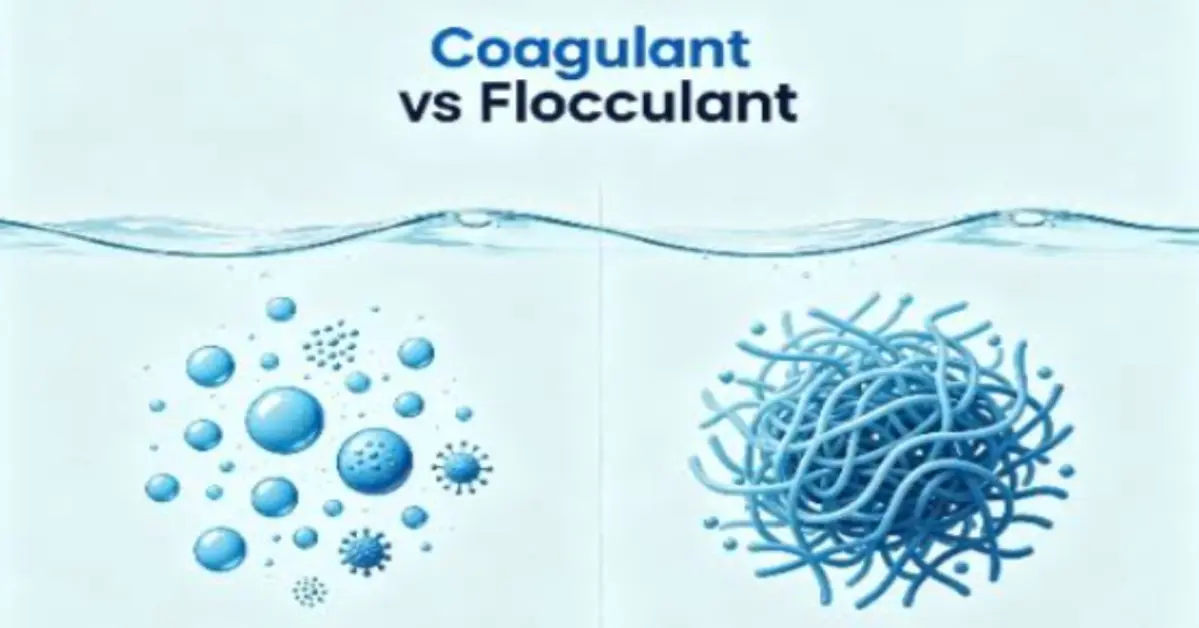
Although they are often mentioned together, they do different jobs. Coagulation destabilizes small particles, while flocculation brings those destabilized particles together into larger aggregates called flocs. Understanding the difference between these two processes is important when designing or optimizing drinking water, industrial water, and wastewater treatment systems.
In this guide, we explain flocculants vs coagulants, how each chemical works, their common types, dosing considerations, applications, and how to select the right treatment chemical.
What Is the Difference Between Coagulants and Flocculants?
The main difference between coagulants and flocculants is their role in particle removal.
A coagulant destabilizes suspended and colloidal particles by reducing or neutralizing the electrical charges that keep them separated. Once these particles become destabilized, they can come together more easily.
A flocculant is generally added after coagulation to encourage the destabilized particles to join together and form larger, stronger flocs. These larger particles can then be separated through sedimentation, clarification, flotation, or filtration.
In simple terms:
Coagulation → particle destabilization → Flocculation → floc formation → separation
This distinction is important because using the wrong chemical, dosage, or treatment sequence can reduce removal efficiency and increase chemical consumption or sludge production.
Coagulant vs Flocculant: How Do They Work?
How Coagulants Work?
Many suspended and colloidal particles in water have similar electrical charges, causing them to repel each other. Because of this repulsion, the particles can remain suspended for long periods.
During coagulation, a chemical is introduced and rapidly mixed with the water. The coagulant reduces or neutralizes the forces that keep the particles apart. This process is known as charge neutralization or particle destabilization.
Common coagulants include aluminum- and iron-based chemicals, as well as certain organic polymers. The appropriate choice depends on factors such as water chemistry, pH, contaminant characteristics, and the desired treatment outcome.
How Flocculants Work?
After coagulation, the destabilized particles need to come together. Flocculants assist this process by promoting particle aggregation. Polymer-based flocculants can attach to multiple particles and create connections between them, a mechanism commonly known as polymer bridging.
The small aggregates gradually combine into larger flocs. These flocs can then settle or be removed through other downstream separation processes. Flocculant performance can depend heavily on molecular weight, charge density, dosage, mixing conditions, and the characteristics of the water being treated.
Coagulation and Flocculation Process
Although coagulation and flocculation are different processes, they are commonly used as consecutive stages in a water treatment system.
1. Rapid Mixing
The coagulant is rapidly dispersed throughout the water. Effective mixing allows the chemical to interact with suspended and colloidal particles.
2. Particle Destabilization
The coagulant reduces particle repulsion and destabilizes the contaminants.
3. Slow Mixing
After rapid coagulation, the water enters a slower mixing stage. A flocculant may be introduced to encourage particles to collide and combine.
4. Floc Formation
Small particles aggregate into progressively larger flocs. The objective is to produce flocs that are large and strong enough for effective separation.
5. Separation
The resulting flocs can be removed using processes such as:
- Sedimentation
- Clarification
- Dissolved air flotation (DAF)
- Filtration
- Sludge dewatering
The exact treatment sequence varies according to the application and characteristics of the water.
Types of Coagulants Used in Water Treatment
Coagulants can generally be divided into inorganic and organic categories.
Inorganic Coagulants
Common inorganic options include:
- Aluminum sulfate, commonly called alum
- Ferric chloride
- Ferric sulfate
- Polyaluminium chloride (PAC)
These chemicals are widely used for destabilizing suspended solids and colloidal contaminants.
The choice between aluminum- and iron-based products depends on the water chemistry, pH, contaminant load, treatment objectives, and process conditions.
Organic Coagulants
Organic coagulants include polymer-based products such as polyamines and PolyDADMAC.
They can provide efficient charge neutralization and may be useful when lower chemical dosages, faster treatment, or specific sludge characteristics are required. However, product selection should be based on actual water characteristics rather than assuming that one type is universally better.
Types of Flocculants Used in Wastewater Treatment
Flocculants are commonly available as polymers with different charge characteristics.
Cationic Flocculants
Cationic polymers carry a positive charge and can be useful for wastewater streams containing negatively charged particles or organic matter. They are also commonly considered in sludge dewatering applications.
Anionic Flocculants
Anionic polymers carry a negative charge and are often used where positively charged or inorganic particles are present. Their performance depends on the properties of the wastewater and the type of coagulant used before them.
Nonionic Flocculants
Nonionic polymers have relatively little ionic charge and can be appropriate for certain water chemistries where strongly charged polymers are not the best choice.
The most suitable polymer cannot be determined from charge alone. Molecular weight, charge density, particle characteristics, pH, dosage, and mixing conditions all influence performance.
When Should You Use a Coagulant or Flocculant?
In many treatment systems, the answer is not coagulant or flocculant but coagulant followed by flocculant.
A coagulant is typically used when very fine or colloidal particles need to be destabilized. A flocculant is then used when those destabilized particles need additional aggregation to create larger flocs that can be separated more efficiently. However, some systems may work effectively with a coagulant alone, while others may require a polymer or a combination of treatment chemicals.
The right approach depends on:
- Water or wastewater composition
- Particle size and concentration
- Surface charge
- pH and alkalinity
- Organic content
- Desired removal efficiency
- Separation equipment
- Sludge characteristics
- Chemical dosage
For this reason, laboratory testing is often more reliable than selecting a chemical based solely on its generic product category.
Can Coagulants and Flocculants Be Used Together?
Yes. In fact, using them together is common in many water and wastewater treatment processes.
The coagulant first destabilizes the particles. The flocculant then promotes aggregation and helps create larger flocs. However, dosage and mixing sequence are critical. Too much coagulant or polymer can interfere with floc formation instead of improving it.
A typical treatment sequence may therefore look like:
Coagulant addition → rapid mixing → flocculant addition → gentle mixing → clarification or separation
The exact sequence and chemical dosage should be established through process testing.
How to Choose a Coagulant for Wastewater Treatment?
Choosing a coagulant requires more than looking at the contaminant name. The chemical should be evaluated against the complete water chemistry and treatment process.
Important factors include:
Water Chemistry
pH, alkalinity, temperature, dissolved organic matter, and ionic composition can influence coagulant performance.
Type of Contaminants
Suspended solids, colloids, organic compounds, color, metals, and other contaminants may respond differently to treatment chemicals.
Required Separation Method
A chemical that performs well in a sedimentation system may not necessarily provide the same results in DAF or filtration.
Sludge Production
Different coagulants can produce different quantities and characteristics of sludge. This can affect downstream handling and disposal.
Treatment Cost
Chemical price should not be the only consideration. The effective dosage, treatment efficiency, sludge generation, and downstream operating costs can have a greater impact on total treatment cost.
How to Choose a Flocculant for Wastewater Treatment?
Selecting a polymer requires careful evaluation of both the wastewater and the treatment equipment.
The main considerations include:
Charge type: Cationic, anionic, or nonionic polymers may behave differently depending on particle characteristics.
Molecular weight: This influences polymer chain length and its ability to form bridges between particles.
Charge density: The amount of ionic charge can affect interaction with suspended particles.
Dosage: Increasing polymer dosage does not necessarily improve treatment. An excessive amount can sometimes reduce flock quality.
Mixing: Excessive shear can break newly formed flocs, while insufficient mixing may prevent effective aggregation.
Final separation: The ideal polymer may differ depending on whether the system uses clarification, DAF, filtration, or sludge dewatering.
What Is Coagulant and Flocculant Dosing?
Chemical dosing is one of the most important factors affecting coagulation and flocculation performance.
There is no universal dosage that works for every water source or wastewater stream. The required amount depends on the concentration and nature of the contaminants, chemical characteristics, pH, temperature, mixing conditions, and treatment objectives.
A jar test is commonly used to compare chemicals and identify an effective dosage range before implementing or modifying full-scale treatment.
The objective is not simply to add more chemical.Instead, operators aim to achieve effective particle destabilization and flock formation with an appropriate chemical dose.
Applications of Coagulants and Flocculants
These chemicals are used across a wide range of treatment processes.
Industrial Wastewater Treatment
Manufacturing facilities may use coagulation and flocculation to remove suspended solids, color, oils, metals, and other contaminants from wastewater.
Drinking Water Treatment
Coagulation and flocculation can help remove particles and turbidity before clarification and filtration.
Food and Beverage Processing
Food-processing wastewater can contain suspended solids, fats, oils, proteins, and organic matter that may require chemical clarification.
Textile Wastewater
Textile effluent may contain dyes, suspended solids, and other compounds. Chemical treatment can be used as part of a broader treatment process.
Mining Applications
Coagulants and flocculants can assist with solids separation in mineral-processing and mining wastewater systems.
Sludge Dewatering
Polymer flocculants are widely considered in sludge-conditioning applications before mechanical dewatering using equipment such as filter presses, centrifuges, and belt presses.
Coagulation vs Flocculation: Key Differences
| Feature | Coagulation | Flocculation |
| Main purpose | Destabilize particles | Aggregate particles |
| Primary mechanism | Charge neutralization/destabilization | Particle bridging and aggregation |
| Typical mixing | Rapid | Slow/gentle |
| Common chemicals | Alum, ferric chloride, PAC, organic coagulants | Polyacrylamide and other polymers |
| Result | Destabilized particles | Larger flocs |
| Next stage | Flocculation | Sedimentation, flotation or filtration |
The two processes therefore complement each other but should not be treated as interchangeable.
Choosing a Coagulant and Flocculant Supplier
A reliable chemical supplier should be able to provide consistent product quality and suitable specifications for the intended application.
When comparing coagulant suppliers in UAE or flocculant suppliers in UAE, consider:
- Product specifications
- Available grades and formulations
- Packaging options
- Supply consistency
- Application suitability
- Technical documentation
- Delivery requirements
- Support with product selection
For larger industrial applications, it is also useful to discuss the water characteristics and existing treatment process before selecting a product.
Frequently Asked Questions
Is a coagulant the same as a flocculant?
No. A coagulant primarily destabilizes suspended and colloidal particles, while a flocculant helps those particles aggregate into larger flocs.
What comes first, coagulation or flocculation?
Coagulation normally comes first. The particles are destabilized during rapid mixing, followed by flocculation under gentler mixing conditions.
Can coagulants and flocculants be used together?
Yes. They are frequently used together when the treatment system requires both particle destabilization and enhanced floc formation.
Which is better, a coagulant or flocculant?
Neither is universally better because they perform different functions. The appropriate chemical depends on the water chemistry, contaminants, treatment process, and separation method.
How do you select a flocculant?
Selection should consider polymer charge, molecular weight, charge density, wastewater characteristics, dosage, mixing conditions, and the downstream separation process. Jar testing can help identify the most suitable option.
What chemicals are commonly used for coagulation?
Common options include alum, ferric chloride, ferric sulfate, PAC, and certain organic coagulants such as polyamines and PolyDADMAC.
What is polyacrylamide used for in wastewater treatment?
Polyacrylamide is a polymer commonly used as a flocculant to promote particle aggregation and improve solids separation. Different polymer grades can have different charge characteristics and molecular weights.
Conclusion
Understanding flocculants vs coagulants is essential for designing an effective chemical treatment process. Coagulants destabilize fine particles, while flocculants promote aggregation and produce larger flocs that can be separated through settling, flotation, or filtration.
The most effective treatment strategy depends on the specific water chemistry, contaminants, equipment, and operating conditions. Rather than choosing a product based only on its chemical category, facilities should evaluate dosage, charge characteristics, molecular weight, mixing conditions, and treatment performance.