Adsorbents for gas purification are essential for removing unwanted contaminants from industrial gas streams and maintaining efficient gas processing. They can help remove moisture, carbon dioxide (CO₂), VOCs, sulfur compounds, and other impurities that may affect equipment performance, product quality, and downstream processes.
Industries in the UAE use different adsorbents for gas purification, gas dehydration, and industrial gas drying across chemical, petrochemical, natural gas, hydrogen, and manufacturing applications. This guide explains the major types of gas purification adsorbents, how they work, their industrial uses, and what to consider when choosing an adsorbent supplier in the UAE.
What Are Adsorbents for Gas Purification?
Adsorbents are solid materials that attract and retain specific molecules from a gas stream on their surface or within their internal pore structure. Unlike absorption, where a substance penetrates into the bulk of another material, adsorption occurs primarily at the surface and within the pores of the adsorbent.
The effectiveness of an adsorbent depends on characteristics such as:
- Pore size and distribution
- Surface area
- Molecular affinity
- Adsorption capacity
- Operating temperature and pressure
- Type and concentration of contaminants
- Regeneration requirements
This selective behavior allows different adsorbents to target different contaminants. For example, molecular sieves are commonly selected for moisture removal and gas dehydration, while activated carbon can be highly useful for VOC and certain organic contaminant removal.
How Adsorbents Work in Gas Purification?
Understanding how adsorbents work in gas purification helps industries choose the appropriate material for a specific application. During adsorption, a contaminated gas passes through a bed containing an adsorbent. Target molecules interact with the surface and pores of the adsorbent and become temporarily retained. The purified gas then exits the adsorption vessel.
A simplified process is:
Contaminated gas → Adsorption bed → Contaminants retained → Purified gas
Once the adsorbent approaches its working capacity, it needs to be regenerated or replaced, depending on the material and process design. Regeneration can involve methods such as heating, pressure reduction, vacuum, or purge gas. Industrial systems may use multiple beds so that one vessel can operate in adsorption mode while another is being regenerated.
Types of Adsorbents Used in Gas Purification
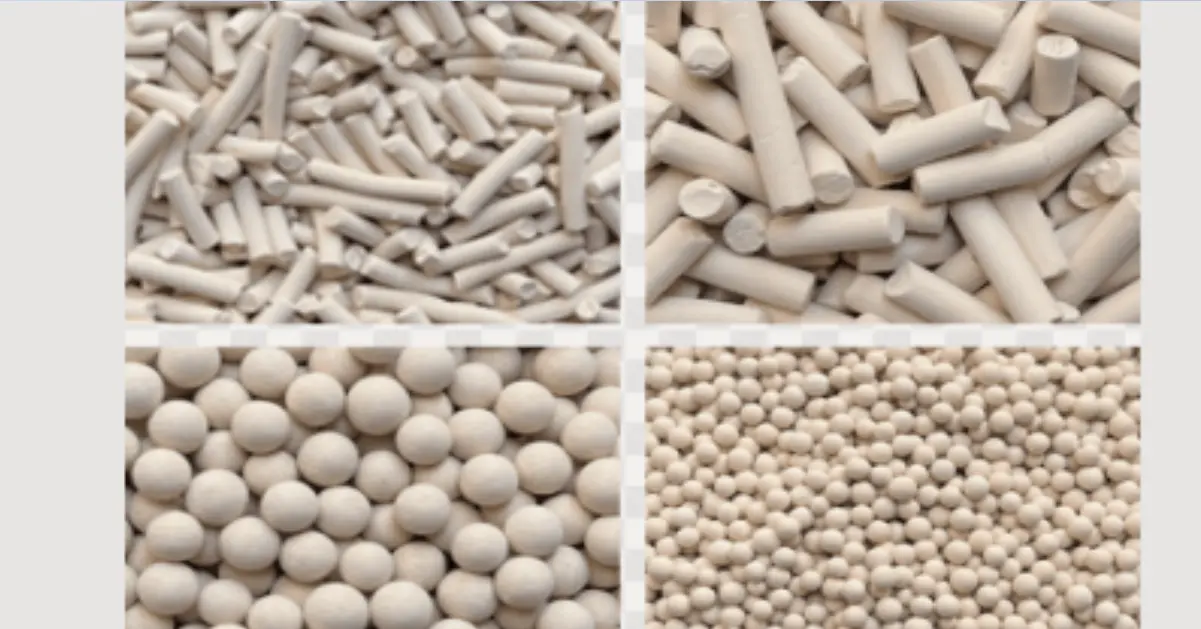
Different contaminants require different adsorption characteristics. The main types of adsorbents used in gas purification include molecular sieves, activated carbon, silica gel, and activated alumina.
1. Molecular Sieve for Gas Purification
A molecular sieve for gas purification is a crystalline adsorbent with highly uniform pores. Its controlled pore structure enables selective adsorption of molecules based on size and affinity.
Molecular sieves are widely used for:
- Gas dehydration
- Moisture removal
- Natural gas treatment
- Air separation
- Hydrogen purification
- CO2 removal
- Hydrocarbon processing
Molecular sieves are especially useful when very low moisture levels are required.
Different molecular sieve grades have different pore structures and adsorption characteristics. Therefore, the correct grade should be selected according to the gas composition and required purification specification.
2. Activated Carbon for Gas Purification
Activated carbon for gas purification is valued for its high internal surface area and porous structure.
It can adsorb many organic compounds and is commonly considered for applications involving:
- VOC removal
- Odor control
- Hydrocarbon vapor removal
- Organic contaminant removal
- Industrial emission treatment
Activated carbon can be produced from different raw materials, and its performance depends on factors such as pore structure, surface chemistry, particle size, and activation method. For applications involving organic vapors, activated carbon can provide effective adsorption when appropriately selected and operated.
3. Silica Gel for Gas Purification
Silica gel for gas purification is a porous material with strong affinity for water.
It is widely used where moisture control is required, including gas drying and humidity management.
Silica gel can be suitable for:
- Moisture removal
- Gas drying
- Air drying
- Compressed gas drying
- Humidity control
- Industrial gas treatment
Its high water adsorption capacity makes it a useful desiccant for applications where moisture needs to be reduced.
4. Activated Alumina for Gas Purification
Activated alumina for gas purification is another porous adsorbent used for drying and contaminant removal.
It has a high surface area and can be used in applications involving:
- Gas drying
- Moisture removal
- Compressed air treatment
- Industrial gas dehydration
- Liquid and gas purification
Activated alumina can also be used as a support material in certain purification systems. The appropriate adsorbent depends on the gas composition, moisture level, operating conditions, and required outlet specification.
Gas Purification Process Using Adsorbents
The gas purification process using adsorbents typically consists of several stages.
Step 1: Feed Gas Entry
The contaminated gas enters the purification system at a controlled flow rate, temperature, and pressure.
Step 2: Pretreatment
Depending on the application, filters or other equipment may be used to remove particulates, oil aerosols, or other contaminants that could reduce adsorbent performance.
Step 3: Adsorption
The gas passes through an adsorption vessel containing the selected adsorbent.
Target contaminants are captured by the adsorbent while purified gas continues downstream.
Step 4: Monitoring
Important parameters such as pressure drop, moisture concentration, contaminant concentration, and breakthrough are monitored.
Step 5: Regeneration
Once the adsorbent reaches its working capacity, the bed can be regenerated under suitable conditions.
Step 6: Reuse
After regeneration, the adsorbent is returned to adsorption service. Multiple bed configurations can allow continuous operation.
Application of Adsorbents
Natural Gas Purification and Dehydration
Natural gas can contain water vapor, carbon dioxide, hydrogen sulfide, hydrocarbons, and other contaminants. An important step before gas enters pipelines, processing facilities, or downstream applications.
Natural Gas Dehydration
Natural gas dehydration focuses on reducing water content in the gas stream. Removing moisture can help reduce:
- Corrosion
- Hydrate formation
- Pipeline problems
- Equipment damage
- Gas quality issues
Molecular sieve systems are commonly considered for applications where deep dehydration is required. For companies operating in the UAE energy and petrochemical sector, reliable gas treatment technologies can support efficient processing and moisture control.
Hydrogen Purification
Hydrogen purification is another important application of adsorption technology. Raw hydrogen streams may contain water vapor, carbon monoxide, carbon dioxide, methane, nitrogen, and other gases depending on the production process. Adsorbents can selectively capture impurities while allowing hydrogen to pass through the purification system.
The appropriate technology depends on the hydrogen source and purity requirement. Adsorption based systems, including pressure swing adsorption, can be used in industrial hydrogen purification processes.
See how Molecular Sieve Works in Hydrogen Purification
Air Separation Using Adsorbents
Air separation involves separating the major components of air, primarily nitrogen and oxygen. Molecular sieves and zeolitic adsorbents can selectively adsorb certain components based on their molecular characteristics.
Adsorption based air separation is used in applications such as:
- Oxygen production
- Nitrogen generation
- Industrial gas production
- Medical and technical gas systems
The adsorbent grade and system configuration depend on the desired gas purity and production rate.
CO2 Removal Using Adsorbents
CO2 removal is an important part of many gas purification processes. Carbon dioxide may need to be removed from natural gas, hydrogen streams, biogas, syngas, or other industrial gases.
Different adsorbent materials can be selected depending on:
- CO2 concentration
- Gas composition
- Operating pressure
- Temperature
- Required CO2 removal level
- Regeneration method
Molecular sieves and other specialized adsorbents may be used for CO2 separation in appropriately designed systems.
VOC Removal Using Activated Carbon
Volatile organic compounds can be released from chemical processing, storage, solvent handling, and industrial operations. VOC removal using activated carbon is a common adsorption based approach.
Activated carbon can capture many organic molecules due to its highly developed pore structure and surface area.
Applications can include:
- Solvent vapor control
- Industrial emission treatment
- Chemical processing
- Odor control
- Air purification
- Hydrocarbon vapor adsorption
The activated carbon grade should be selected according to the specific VOC, concentration, humidity, temperature, and flow conditions.
How to Select the Best Adsorbent for Gas Purification?
Finding the best adsorbent for gas purification requires an evaluation of the complete process.
Identify the Contaminant
First determine whether the target impurity is water, VOCs, CO2, sulfur compounds, or another contaminant.
Analyze the Gas Composition
The presence of multiple gases can influence adsorption performance.
Check Operating Conditions
Temperature, pressure, flow rate, and humidity can affect adsorption capacity and breakthrough time.
Determine Required Gas Purity
The required outlet specification will determine the appropriate adsorbent and system design.
Consider Regeneration
For reusable adsorbents, determine how regeneration will be performed and how frequently it will be required.
Evaluate Adsorbent Life
A suitable material should maintain acceptable performance over the expected number of adsorption and regeneration cycles.
Frequently Asked Questions
What are adsorbents used for gas purification?
Adsorbents are used to selectively remove contaminants such as water vapor, VOCs, CO2, sulfur compounds, and other impurities from gas streams.
How do adsorbents purify gas?
Contaminated gas passes through an adsorbent bed. Target molecules are captured on the adsorbent’s surface or within its pores, while the treated gas exits the vessel.
What is the best adsorbent for gas dehydration?
Molecular sieves, silica gel, and activated alumina can all be used for gas drying depending on the required moisture level and operating conditions. Molecular sieves are often selected when very low residual moisture is required.
Can activated carbon remove moisture from gas?
Activated carbon can adsorb some moisture, but it is generally not the first choice when deep gas dehydration is required. Dedicated desiccants such as molecular sieve, silica gel, or activated alumina may be more appropriate depending on the application.
What is the difference between adsorption and absorption?
Adsorption occurs when molecules are retained on a material’s surface or within its pores. Absorption involves a substance entering the bulk of another material.
Conclusion
Adsorbents for gas purification play an important role in modern industrial gas treatment. By selectively capturing unwanted molecules, adsorbents can help remove moisture, VOCs, CO2, and other contaminants from gas streams.
Whether you need a molecular sieve supplier, activated carbon supplier, silica gel supplier, or broader industrial adsorption solution, product selection should be based on gas composition, contaminant concentration, operating conditions, required purity, and regeneration requirements.
OozeChem provides industrial adsorbents, including molecular sieves, activated carbon, silica gel, and activated alumina, for gas drying, purification, and moisture removal applications. Contact OozeChem to discuss the appropriate adsorbent for your UAE or GCC industrial process.