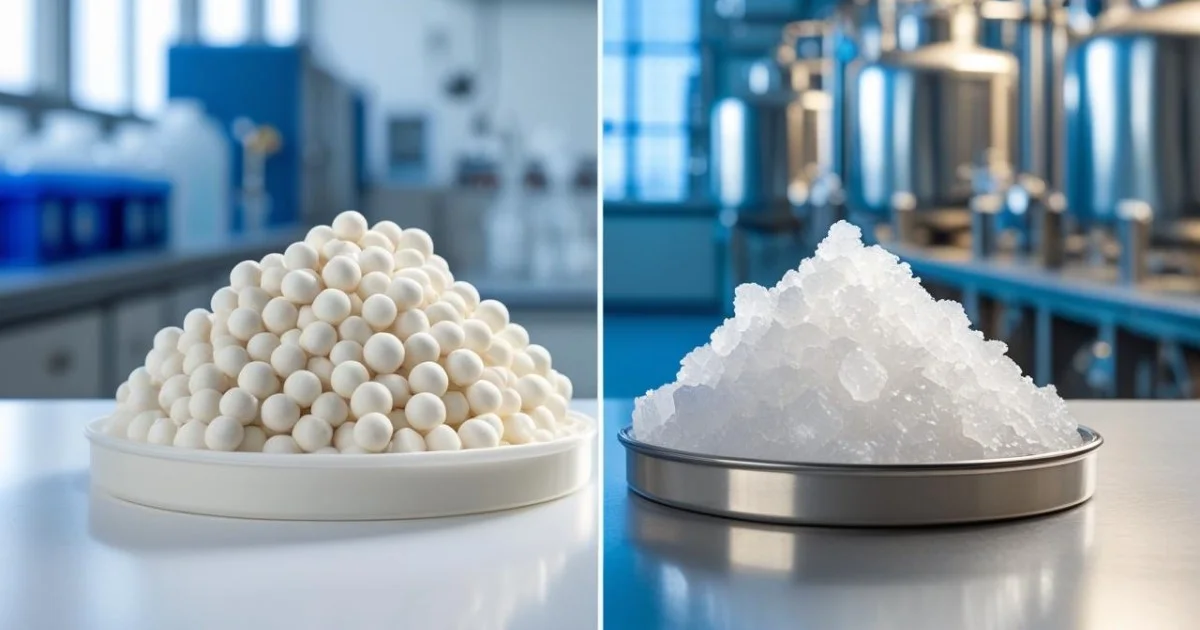
Choosing between activated alumina and silica gel is one of the most important decisions when selecting the best desiccant for industrial applications and moisture control systems. This activated alumina vs silica gel comparison helps businesses understand the key differences between these widely used moisture adsorption materials, including their adsorption capacity, temperature resistance, regeneration requirements, and operating costs. As two of the most effective industrial drying agents, activated alumina and silica gel offer distinct advantages depending on the application, operating environment, and performance requirements. Understanding these differences helps industries select the most efficient and cost-effective drying solution for long-term moisture management.
Key Differences Between Activated Alumina and Silica Gel
| Feature | Activated Alumina | Silica Gel |
|---|---|---|
| Best For | High temperatures | Packaging & storage |
| Cost | Higher | Lower |
| Regeneration | Higher temperature | Lower temperature |
| Durability | Excellent | Good |
| Water Capacity | Moderate | High |
Understanding Activated Alumina and Silica Gel
What is Activated Alumina?
Activated alumina is a highly porous material primarily composed of aluminum oxide (Al₂O₃). Created through controlled heating of aluminum hydroxide at high temperatures, this process removes water molecules while creating an extensive network of interconnected pores. The resulting crystalline lattice structure provides exceptional surface area for moisture adsorption, making it a preferred choice for demanding industrial applications.
What is Silica Gel?
Silica gel, despite its name, is a solid granular material made from silicon dioxide (SiO₂). This synthetically manufactured desiccant features microscopic pores that create a vast internal surface area. Its versatility and cost-effectiveness have made it a popular choice across various industries, from pharmaceutical packaging to electronics protection. Oozechem offers range of silica gel desiccants:
- White silica gel
- Grey Silica Gel
- Orange Silica Gel
- Blue Silica Gel
- Also check Silica Gel Applications
Performance Comparison: Activated Alumina vs Silica Gel
Adsorption Capacity Analysis
| Property | Activated Alumina | Silica Gel |
| Maximum Water Capacity | 17-20% by weight | 35-40% by weight |
| Optimal RH Range | 20-60% | 10-40% |
| Pore Size | 32-58 Å | 22-24 Å |
| Surface Area | 200-300 m²/g | 750-800 m²/g |
| Bulk Density | 0.75-0.85 g/cm³ | 0.70-0.75 g/cm³ |
While silica gel demonstrates higher overall adsorption capacity, activated alumina excels in specific humidity ranges and maintains consistent performance under varying conditions.
Temperature Performance
The comparison of silica gel vs activated alumina reveals significant differences in thermal stability. Activated alumina maintains its structural integrity and adsorption efficiency at temperatures up to 400°C, making it ideal for high-temperature applications in oil and gas processing. Silica gel, while effective at moderate temperatures, begins to lose efficiency above 180°C.
Regeneration Characteristics
Activated Alumina Regeneration:
- Requires temperatures of 200-350°C
- Energy-intensive process
- Maintains structure through multiple cycles
- Longer regeneration time (4-8 hours)
Silica Gel Regeneration:
- Regenerates at 120-180°C
- Lower energy consumption
- Faster regeneration cycles (2-4 hours)
- More frequent regeneration needed
Application-Specific Performance
Water Treatment Applications
In water treatment systems, activated alumina desiccant vs silica gel performance varies based on specific requirements. Activated alumina demonstrates superior performance in removing fluoride and arsenic from water systems, while silica gel excels in general moisture control applications.
Industrial Gas Processing
For industrial gas drying applications, activated alumina vs silica gel selection depends on operating conditions. Activated alumina provides better performance in natural gas processing and compressed air systems due to its stability under pressure and temperature variations.

Pharmaceutical and Food Industries
The pharmaceutical industry often favors silica gel for packaging applications due to its indicator capabilities and precise moisture control. However, activated alumina finds applications in drug manufacturing processes where high-temperature drying is required.
Check Silica Gel For Food Packaging
Environmental Impact and Sustainability
Both materials offer environmental advantages, but their sustainability profiles differ:
Activated Alumina:
- Made from abundant aluminum ore
- Fully recyclable
- No toxic byproducts
- Energy-intensive manufacturing
Silica Gel:
- Derived from silicon dioxide (sand)
- Biodegradable options available
- Lower manufacturing energy requirements
- Easy disposal
Selection Guidelines
Choose Activated Alumina When:
- Operating temperatures exceed 200°C
- High humidity environments (>60% RH)
- Long-term stability is critical
- Chemical resistance is required
- Working with corrosive gases
Choose Silica Gel When:
- Cost is a primary concern
- Moderate temperature applications (<180°C)
- Quick moisture adsorption needed
- Indicator functionality required
- Frequent regeneration is acceptable
FAQS
Which is better, activated alumina or silica gel?
The choice depends on operating conditions. Activated alumina performs better in high-temperature industrial environments, while silica gel is often preferred for packaging and storage applications.
Does activated alumina absorb more moisture than silica gel?
Silica gel generally has a higher moisture adsorption capacity, but activated alumina offers better performance at elevated temperatures.
Can activated alumina replace silica gel?
In many industrial drying applications, yes. However, the best choice depends on humidity levels, temperature, and regeneration requirements.
Which desiccant lasts longer?
Activated alumina typically provides a longer service life in demanding industrial environments.
Conclusion
The choice between activated alumina vs silica gel ultimately depends on your specific application requirements, operating conditions, and economic considerations. While silica gel offers cost-effectiveness and versatility for moderate-temperature applications, activated alumina provides superior performance in high-temperature, high-humidity environments.
For expert guidance on selecting the optimal desiccant solution for your application, OozeChem today. Our technical team can help you evaluate your specific requirements and recommend the most cost-effective solution for your industrial needs.